


On a website build, scope creep tends to land on the one company that neither asked for the extra work nor bills for it by the hour. That’s the agency in the middle, between a client who pays a fixed price and a developer who charges for time. The middle seat is the expensive one. We’ve built websites since 2008, including as the developer behind agencies, and the scope creep examples below are the five we keep seeing. For each, you’ll get what it costs you and what to agree before the build starts.
Why the overrun lands on the agency
With three parties on a build, the overrun goes to whoever holds the gap between two pricing models. Your client pays you a fixed price. Your developer bills you by the hour. So every hour nobody priced comes out of your margin, and your client never sees it unless you send an invoice they weren’t expecting.
PMI’s 2018 Pulse of the Profession describes scope creep as scope that grows with no matching change to time, cost or resources. Its survey found that 52% of projects completed in the previous 12 months had scope creep or uncontrolled changes to their scope, up from 43% five years before. A website build has no special immunity. An agency carries an extra risk on top, because the people asking for more and the people billing for it work for two different companies. You’re the one standing between them.
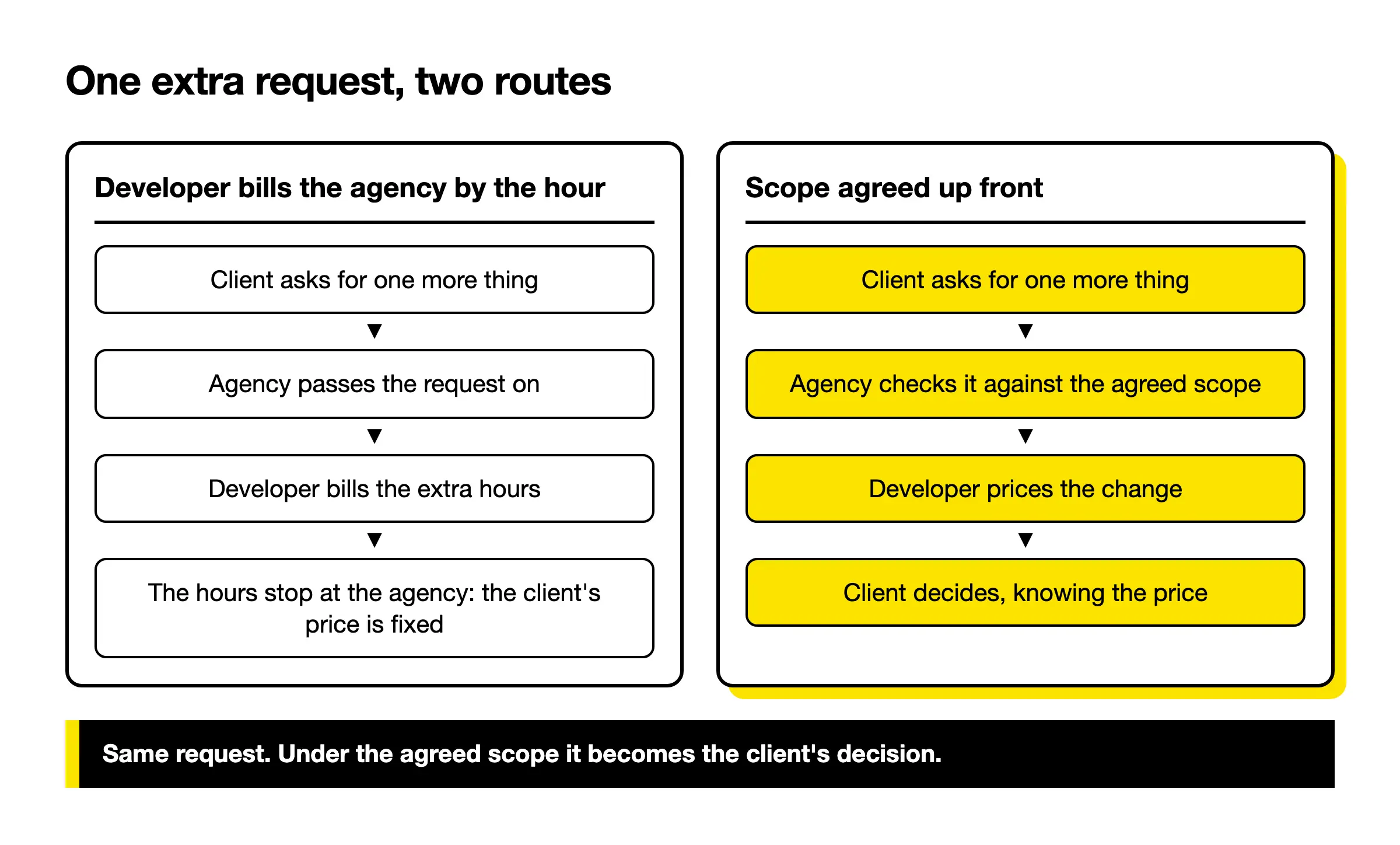
A scope agreed with your developer before the build starts changes the route a request takes. Instead of turning into hours on next month’s invoice, it becomes a decision with a price attached, and that decision goes back to the client who asked.
Same request. Very different conversation.
That’s how we set up work with agencies. We quote a fixed bid by default, and we help the agency scope and estimate the site before its client signs. We reopen a fixed bid only when the scope changes in a meaningful way. When it doesn’t change, we deliver within our estimate.
The integration nobody priced
The scope creep example we see most often is a third-party integration promised to a client inside a fixed budget. It might be a CRM sync, a booking system or a member login. Some are quick. Others keep growing, because the other system doesn’t behave the way its documentation says it will. You often can’t tell which kind it is until someone starts building.
We try to train our agency partners to be careful about promising integrations. The budget for one is easy to give away and hard to get back, and no one wants to keep pouring money into a connection that refuses to work.
So when an integration starts to sprawl, we keep helping, but at some point we pause and ask the client to decide whether the feature is still worth it. That pause is there to protect you. It stops your budget draining into work your client might not want at that price. It also hands the decision to the person who asked for the feature, at a moment when they still have a real choice (which beats a surprise bill after launch by a mile). Your relationship with the client stays intact, because you brought them a decision instead of a problem. And the developer stays on your side of the table.
The up-front fix is a list. Before you quote, name every system the site will talk to: the CRM, the email platform, the booking or payment tool, anything that sends or receives data. Each one becomes a line in the scope. In our bids for agencies, an integration with a tested plugin is priced like the rest of the build. One without gets the closest estimate we can give, with an honest note that the work may pause if it runs into problems, often while we wait on the third party’s own support team.
The pages nobody priced
Halfway through the build, the client remembers the careers page. Or the services section grows from one page into six. Under an hourly quote, each addition simply becomes more hours. With the page and template list written into the scope, it’s a priced addition the client can approve or push to a second phase.
That list matters. On a build from finished designs, our bid is sized by the number of pages and templates, the design sections our base theme doesn’t already have, integrations, and a WooCommerce shop or a second language. If you’re writing a brief for the build, put the full page and template list in your RFP rather than describing the site in general terms.
It’s a short job. It saves arguments later.
Not every extra page is a meaningful change, though. We treat two kinds of growth here as meaningful. One is a new custom post type, which is a new kind of content, like job openings or case studies, with its own fields and templates. The other is a big jump in how much content the site has to take on.
A grown scope doesn’t have to wreck a launch date. Genea, a property-technology company, needed a rebuild that brought its products under one roof. When the scope grew on our rebuild for Genea, the site needed about 25 more pages than planned. We took on the extra work and still launched on the original date.
The third round of design changes
The client signs off the designs and development starts. A few weeks later the homepage is up for debate again. This one stings. A change to something already built means undoing work as well as doing new work. So once high-fidelity designs are approved and built, changing large parts of them is paid work.

Smaller adjustments are a different matter. Before an agency sees one of our builds, someone other than the developer who built it tests it on current browsers and phones. The agency then reviews it on a staging link. Review rounds carry on until sign-off within the agreed scope, and a round that changes the scope counts as a scope change, which keeps the rounds honest.
Late change doesn’t have to sink a budget when everyone handles it in the open. Porter Novelli’s project went through a fair amount of late-stage change. We kept it within budget and launched it with no defects, through rigorous testing and repeatable development processes.
The trick, if there is one, is agreeing in advance what “approved” means. Then a third round is a decision the client makes knowingly, rather than a favour the agency quietly absorbs.
The old site’s content has to come along
Migration is the scope creep example nobody sees coming, because everyone assumed it. The client thinks the old blog moves over. The developer priced a fresh site with placeholder copy. Up front, write down what moves, who moves it, and in what state it should arrive.
That last part catches people. Years of old blog posts can arrive as they are, broken formatting and missing images included, or cleaned up and re-tagged. Those are two very different jobs. Somebody also has to decide what happens to every old URL. Google’s own guidance on moving a site is to map each old address to its new one and use server-side permanent redirects, which is real work on a site with a long archive. That’s a bad thing to learn in launch week.
When we move an agency’s client to WordPress from Squarespace, Wix or Webflow, we move the pages, blog posts, media, and SEO titles and descriptions, and set up a 301 redirect map. We quote the timing per site.


Launch week, and the quick changes after it
Launch week brings its own requests: a bigger heading here, a banner there for an event nobody mentioned. After launch the small edits keep arriving. One at a time they’re nothing. Billed by the hour through a developer, they turn into a slow leak that no budget line covers.

Two things fix most of it. The first is a launch checklist agreed before launch week, so polish requests are either on the list or they’re new work. The second is giving the edits to the people who want them.
Every engagement we run includes CMS training for the agency’s own marketing team, so a non-technical team can manage the site without a developer. You can see how the editing side of our WordPress builds works for yourself. Porter Novelli has needed only sporadic support since launch and manages its site without developer involvement.
Our agency clients send the small changes that do need a developer as a ticket or a Slack message. We usually handle them within hours, or schedule them for the next day or two. Decide early who pays for that ongoing work, too. We’ve written separately about what agencies should own after launch, and it’s worth settling before the first post-launch request lands.
What a scope agreed up front can’t fix
Some work can’t be scoped before it starts, and pretending otherwise only moves the overrun somewhere harder to see. That work belongs on time and materials. Choose between a fixed bid and hourly billing before the engagement begins, while the choice is still yours.
We quote projects as a fixed bid where the work can be scoped up front, and as time and materials where it can’t. We judge which applies before we start. For the longer comparison, see our piece on fixed bid versus hourly pricing.
There’s a middle route for the most common unknown. When a client wants a full quote on an integration whose effort nobody can know yet, we can run a short discovery sprint first. We dig into the integration and sometimes build a small proof of concept, to confirm the system works as advertised before anyone commits to a build price. The sprint is paid for separately from the build.
And a fixed bid isn’t frozen. We reopen one on a meaningful change of scope: a new custom post type, say, or a big change in how much content the site has to take on. Changing something already approved and built counts too. What we commit to is the agreed scope. A different scope gets a different price.
We can also quote option packages: a base price plus clearly priced extras the client picks from. That turns “maybe later” requests into choices made at the start, when they cost the least to make.
Frequently asked questions
01 Is scope creep always bad?
No. A client who asks for more is often a client who cares about the site. What hurts is growth nobody agreed and nobody priced. Once a request is priced and approved, it stops being creep and becomes a change to the scope, and some of those changes turn out to be the best ideas on the whole project.
02 What’s the difference between scope creep and a scope change?
A scope change is agreed: someone put a price and a date on the request and said yes. Scope creep is the same work arriving without that step. Small or large, what counts is whether the price and the deadline moved with the request. On a website build that usually comes down to whether anyone wrote the change down and priced it before the work began.
03 Who pays for scope creep on a fixed-price project?
Whoever agreed to the fixed price, unless the scope gives them a way to reprice. On a three-party website build that’s usually the agency, because the client’s price is fixed and the developer’s hours get billed either way. A written scope fixes that. With the pages and integrations listed and a clear idea of what counts as a meaningful change, the agency can take a request back to its client as a priced choice.
04 How do you prevent scope creep on a website project?
Agree the scope with your developer before you quote your client. List every page and template, every system the site connects to, what content moves from the old site and who moves it, and what launch week includes. Then decide which requests you’ll absorb and which go back to the client with a price. Write that decision down too.
05 Can a fixed bid change once the build has started?
Yes, when the scope changes in a meaningful way, such as a new content type, a big increase in content, or changes to work that was already approved and built. A fixed bid protects the agreed scope. It doesn’t promise that a different project will cost the same. A good developer partner tells you which side of that line a request falls on before doing the work, so you can take it back to your client first.